You get one set of ears.
Each ear has about 15,000 hair cells. Once they die, they don’t come back: not with pills, not with time. The good news is they’re easy to protect once you know what harms them.
How long you can listen safely
Ears tire from the dose: loudness multiplied by time. At 85 dB, about eight hours a day is safe. Every extra 3 dB cuts that time in half. Drag the scale or pick a source.
Based on the NIOSH recommendation: 85 dBA over 8 hours with a 3 dB exchange rate. Source levels are approximate and depend on distance and the source itself.

What breaks inside
Sound enters the cochlea, and tiny bundles on the hair cells move in response. That’s how mechanical motion turns into a signal for the brain.
Sound that’s too loud bends and breaks these bundles. At first the cells recover: muffled ears after a concert are fine by morning. But every time leaves a mark, and in humans dead hair cells are never replaced.
In animal studies, even temporary deafness after noise destroyed some nerve connections, although hearing tests went back to normal. In humans this is still being studied, but the takeaway is the same: ringing after something loud is a sign of overload, not something normal.

The WHO estimates that more than a billion young people risk losing their hearing to music that’s too loud, in headphones and at concerts.
What it leads to
- Ringing in the ears
- Tinnitus: a whine, hiss or hum that isn’t there outside. About one in seven adults has it. It often starts after noise damage and bothers people most in silence, especially at bedtime.
- Hearing loss
- Noise-induced hearing loss creeps up unnoticed and takes the high frequencies first. Early signs: speech is hard to follow in a café, you keep turning the volume up, and everyone seems to mumble.
- Hyperacusis
- Everyday sounds start to feel too loud or even painful: clinking dishes, a slammed door, a child shouting. It often comes together with tinnitus.
- Sudden hearing loss
- Hearing in one ear drops sharply within hours or overnight, sometimes with ringing and a blocked feeling. See a doctor urgently: treatment works best in the first few days.
How to protect your ears every day
Nothing complicated. Most of these habits take seconds and cost nothing.
-
Earplugs in your pocket
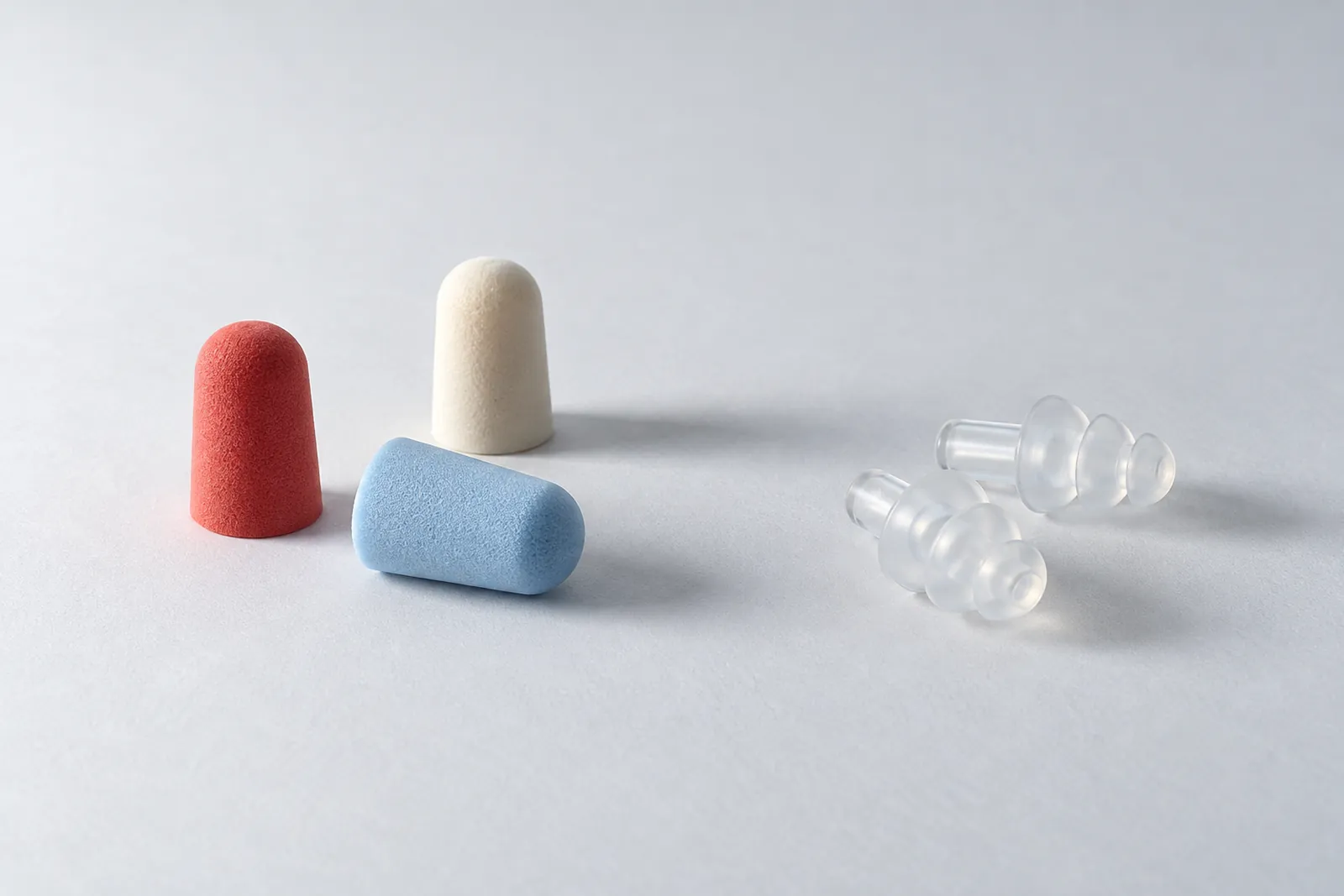
Foam earplugs cut noise by 20–30 dB if you insert them right: roll them into a thin cylinder, pull your ear up and back, and hold until they expand. For concerts there are musician’s earplugs: they reduce sound evenly, so music stays clear.
-
The 60/60 rule
No more than 60% volume in headphones, for no more than 60 minutes at a time, then take a break. Turn on volume limits and sound level alerts on your phone.
-
Noise cancelling, not volume
On the subway or a plane we turn music up to drown out the rumble. Noise-cancelling headphones remove the rumble, so music sounds good at a lower volume.
-
Quiet after loud
After a concert or a club, give your ears at least a day of rest: no headphones and no noisy places. Keep away from the speakers and step into a quiet area every half hour.
-
No cotton swabs
Ears clean themselves, and earwax protects the ear canal. Swabs push wax deeper and can damage the eardrum. Wash only the outer ear. If wax blocks your ear, see an ENT doctor.
-
Hearing checks
Get your hearing checked every year or two by an audiologist, or at least with an app. Early changes go unnoticed, and you can only compare if you have an earlier result.
When silence rings
Ringing is loudest where it’s quiet. Soft background noise makes it less noticeable and helps you fall asleep. That’s why we built the masker: it runs right in your browser and downloads nothing.
- White, pink and brown noise, rain and a fan. Mix them as you like.
- Sleep timer: the sound fades out gently once you’re asleep.
- Find the pitch of your ringing and try an experimental mode that cuts it out of the noise.